Community Disputes Management Framework
The Community Dispute Management Framework promotes neighbourly harmony through mediation, community support, and legal recourse.
Last updated on 2 September 2026

About the Community Disputes Management Framework (CDMF)
The Community Disputes Management Framework (CDMF) resolves neighbour disputes through mediation, community support, and legal recourse. As part of the CDMF, the Community Disputes Resolution Act was passed in 2015, establishing the Community Disputes Resolution Tribunals (CDRT) to hear intractable neighbour disputes after all other avenues, including community mediation, have been exhausted.
The CDMF is regularly reviewed to ensure its continued effectiveness. In 2024, the Community Disputes Resolution (Amendment) Act introduced enhancements including the Mediation Direction framework and the Community Relations Unit (CRU) to facilitate earlier and more effective resolution of neighbour disputes.
What's New from 1 September 2026
From 1 September 2026, the Mediation Direction framework and Community Relations Unit (CRU) will be expanded nationwide, building on the experience of a pilot. This means residents across Singapore will have stronger support to resolve neighbour disputes more effectively and at an earlier stage.
The Mediation Direction Framework
The Mediation Direction Framework is designed to bring disputing neighbours together and facilitate constructive dialogue before disagreements escalate. A Mediation Direction is an order that requires disputing neighbours to attend mediation at the Community Mediation Centre (CMC). These orders are backed by law and must be complied with.
From 1 September 2026, the Mediation Direction framework will be extended nationwide. HDB and PA will be authorised to issue Mediation Directions in public housing estates. PA will also be authorised to issue Mediation Directions in private housing estates. If mediation is successful and both parties consent, the settlement agreement can be registered as a CDRT order, allowing for quicker and simpler legal recourse if the agreement is breached.
The Community Relations Unit (CRU)
While most neighbour disputes can and should be resolved through dialogue and mediation, a small number of cases involve excessive and prolonged noise disturbance that causes significant distress to multiple residents. The CRU can address these severe neighbour noise disputes and hoarding cases, where attempts by neighbours and agencies to resolve the dispute have not been successful.
From 1 September 2026, the CRU will be expanded nationwide to cover both public and private housing estates. CRU officers have legal powers to take statements from disputing neighbours and other individuals, and may issue warnings and abatement orders requiring individuals to stop the noise nuisance. Non-compliance with an abatement order is an offence.
Government intervention through the CRU will be reserved for the most severe neighbour noise cases, after neighbours and agencies have exhausted other avenues or the circumstances warrant such intervention.
More details about the CRU can be found here (opens in new tab).
Enhancements to the Community Disputes Management Framework
An inter-agency committee regularly reviews the Community Disputes Management Framework (CDMF) to ensure its continued effectiveness.
A public consultation was conducted from 11 to 31 May 2023 on the proposed enhancements to the CDMF. A series of engagement sessions were also held in July 2023 with stakeholders such as frontline personnel, academics and members of the public. A summary of the feedback received can be found here.
The Community Disputes Resolution (Amendment) Bill was passed by Parliament on 12 November 2024. The Bill introduced enhancements that facilitate effective resolution of neighbour disputes to promote a stronger, and more gracious and harmonious community for all by:
Encouraging the increased use of community mediation to resolve neighbour disputes at an early stage;
Piloting a new Community Relations Unit to address a small minority of severe neighbour noise disputes and hoarding cases; and
Enhancing the processes and powers of the CDRT, so that cases that are brought before it as a last resort can be resolved more effectively.
More details on the enhancements can be found here.
Neighbours should take time and effort to communicate frequently, with empathy and consideration for each other. Such ties go a long way towards building social capital that can weather everyday friction. For the minority of cases that cannot be resolved via community self-help, the enhanced CDMF will provide a wider range of options to facilitate effective resolution of neighbour disputes.
Getting Help for Your Neighbourly Dispute
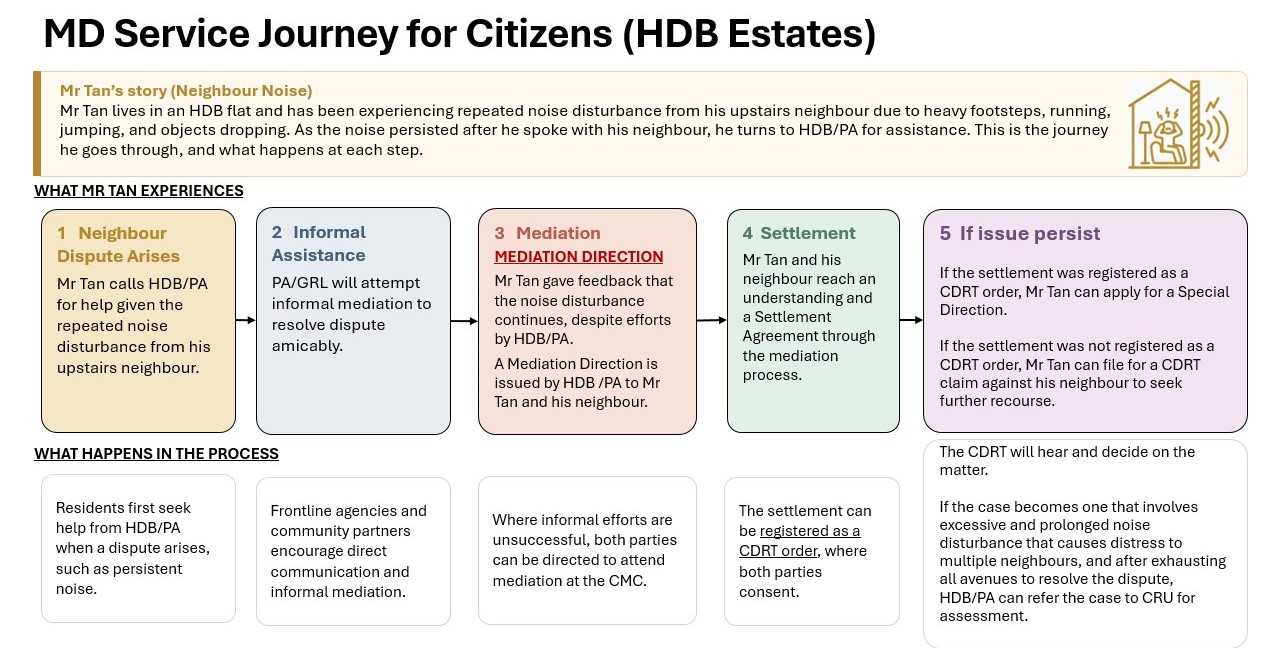
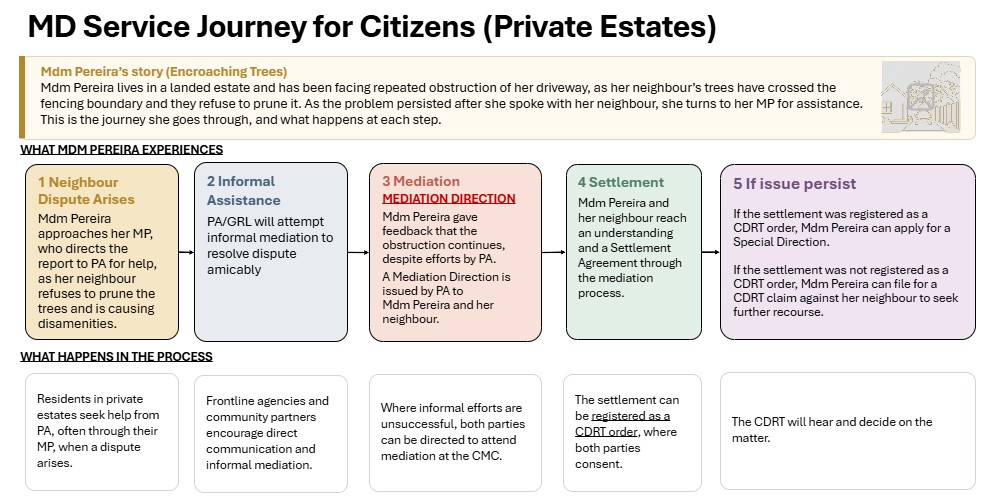
Talk to your neighbour first. Approach and discuss the issue with your neighbour calmly. Amicable resolution can help preserve neighbourly relations. If necessary, seek help from your grassroots leaders through your nearest Community Club (CC). Residents may also submit feedback through the following channels:
For residents living in public or private housing estates: HDB’s Write to Us (opens in new tab) or PA’s Feedback Form (opens in new tab)
For residents living in private housing estates: PA’s Feedback Form (opens in new tab)
OneService App or OneService Kaki chatbot (available on WhatsApp, Telegram or Instagram) for all residents.
HDB and PA will assist where appropriate.
Apply for mediation. If you cannot resolve the dispute on your own, apply for voluntary mediation with the Community Mediation Centre (CMC). You can register your case online (opens in new tab) or call the hotline at 1800-CALL-LAW (1800-2255-529). If mediation is successful and both parties consent, the settlement agreement can be registered as an order of the Community Disputes Resolution Tribunals (CDRT), allowing for quicker and simpler legal recourse if the agreement is breached.
If your neighbour will not come to the table. If your neighbour declines or fails to respond to a mediation invitation, a Mediation Direction can be issued by authorised agencies to direct disputing parties to attend mediation at the CMC. This applies to cases where parties had not previously attempted mediation or failed to respond to a voluntary mediation invitation.
For severe neighbour noise and hoarding cases, the CRU may utilise its investigation and enforcement powers, where attempts by neighbours and agencies to resolve the dispute have not been successful or the circumstances warrant such intervention. HDB and other frontline agencies will assist with the feedback and escalate severe cases to CRU for assessment.
If mediation is unsuccessful. Residents can seek recourse from the CDRT as a last resort, if the dispute remains unresolved even after best efforts at amicable resolution. The CDRT is housed at the State Courts at 1 Havelock Square, Singapore 059724. More information on the CDRT is available here (opens in new tab).
Building Harmonious Communities Together
Neighbours should take time and effort to communicate frequently, with empathy and consideration for each other. Such efforts go a long way towards building social capital that can weather everyday friction.
Ultimately, building harmonious neighbourhoods is a shared responsibility – strong communities are built when neighbours treat one another with consideration, respect, and understanding, and when neighbours come together early to resolve their differences amicably.